
You may have noticed a sudden influx of people becoming coaches and consultants overnight. I want to get one thing clear, the process probably isn’t as overnight as you think, but it may just be the right one that ticks most of your boxes.
I’m covering why coaching and consulting make a great second career when your life doesn’t fit a traditional 9-to-5, what it takes in hours and effort, what holds people back when they start, and the difference between a coach and a consultant so you can decide which one you want to be.
Most coaches and consultants built years of experience before they started
Most coaches and consultants gravitated towards online coaching and consulting after building substantial experience in their field of expertise but the hours and financial return no longer made sense.
There is a group out there who may not have the experience, but let’s not let a few bad apples ruin it for everybody.
From my perspective, these options make a great second career for those who are finding the commitments of a 9-5 no longer work around the challenges that life is throwing at them right now.
Maybe you’ve come from finance, or engineering. Maybe you were a school teacher, a therapist, a fashion designer, an editor, or a writer. Imagine the ability to take all of that experience to help someone who is maybe four or five years behind you and wants to fast-track that process with your expertise.
In my experience working behind many businesses and running one myself, those are the people who make the greatest coaches/consultants.
Right now I see a lot of 21-year-old life coaches with no experience in life teaching middle-aged women why they’re feeling the way they do. This doesn’t make sense in multiple situations. This doesn’t mean 21 year olds can’t be coaches or consultants, but it’s become apparent that the best coaches and consultants are the ones who have had their fair share of personal experience in what they’re teaching.
All this to say that if you’re going to go down this route, ensure you focus on what you really know vs what the latest internet fad is.

It is a real option when your life does not fit a 9-to-5 or set part-time hours
Becoming a coach or consultant is a very good option for people who would like to earn money but can’t go down the path of a traditional 9-to-5, because their circumstances in life don’t allow it.
You’re well-educated. You have tons of experience. But because you can’t meet the requirements of a typical 9-to-5, or typical part-time hours, your earning potential is capped unless you can find a way around it.
When I talk about people who are limited, I’m talking about:
-
Carers of young children
-
Carers of children or adults with additional needs who need extensive hours of care
-
People with their own conditions that don’t allow them to work regular hours, whether full-time or part-time
Maybe you’re fantastic at what you do but the time commitment doesn’t work with your condition, because your condition doesn’t allow you to operate in the way that’s required to do your job.
You’re probably a driven individual and decided that if one workplace can’t make suitable adaptations for you, another one will, but you’ve found it hard to get through the door and you’re met with a questionable reason as to why you did not get the job.
Your next step after tireless effort is to probably change professions to accommodate your health needs, but the other avenues don’t allow you to earn the money you need to look after yourself.
If your life circumstances are very unpredictable, and you still need to earn enough to live a comfortable life with the limited resources you have, coaching and consulting are great career moves to consider.

You have to work hard, but the hours you work are not the deciding factor
Being a self-employed coach or consultant may not be for everybody. Let’s face it, a lot of gurus out there have made entrepreneurship appear to be the fastest and easiest way to earn money. It can also be twice the work.
There are arguments in the online space that if you want to be an entrepreneur, you need to be willing to work hard, and that this work-life balance thing is silly, especially if you want to get to the top.
I kind of agree, and I disagree.
It makes sense because you do have to be willing to do what others are not willing to do. Some people don’t want to keep going after a certain amount of failed attempts or when things don’t go their way. This has been the one skill that I really struggled with initially. Not being able to do this one thing significantly reduces your chances of getting to where you want to be.
But then the argument can be made that not everybody has the capacity to do all it takes. They’re starting a business at a time in their life when there are other responsibilities they can’t drop, and those responsibilities still have to exist while they run a business.
There’s the notion that you cannot be successful because you’re not working as hard as other people. But is this really true?
Business has so many different variables. You cannot say that not working 60 hours a week is going to be the deciding factor in you making a good living from your business. I have seen entrepreneurs working 15-hour weeks and earning a good living. I won’t lie to you and say that’s how they started. They probably had other variables at play to help them get there.
When I talk about variables, I mean things like:
-
Disposable funds
-
Industry connections
-
Business support
-
Personal support
-
Physical health
-
Likability
-
Economic climate
-
Demand
-
Time
-
Mental health
-
Knowledge
All of these are factors in business success, and it is never just time that decides whether your business is going to be successful or not.
All I’m saying is, use a little discernment. See what resources you have right now, and see what you can get started with.

Balance what you need to earn against the hours you have
When you’re a coach or a consultant, you have the ability to set your hours. Of course, the fewer hours you work, especially if you’ve got little experience, the less you can probably earn, unless your skillset and demand attracts higher price points that the market is willing to pay (like Alex Hormozi’s 5-figure workshops).
To create a business model that you can show up for consistently, you’ve got to figure out a way to balance:
-
How much you need to make
-
The perceived value of your services to your client, not to yourself
-
The total work required to get the monthly revenue you need (whether that’s to pay your bills, grow your business, or reinvest back into your business)
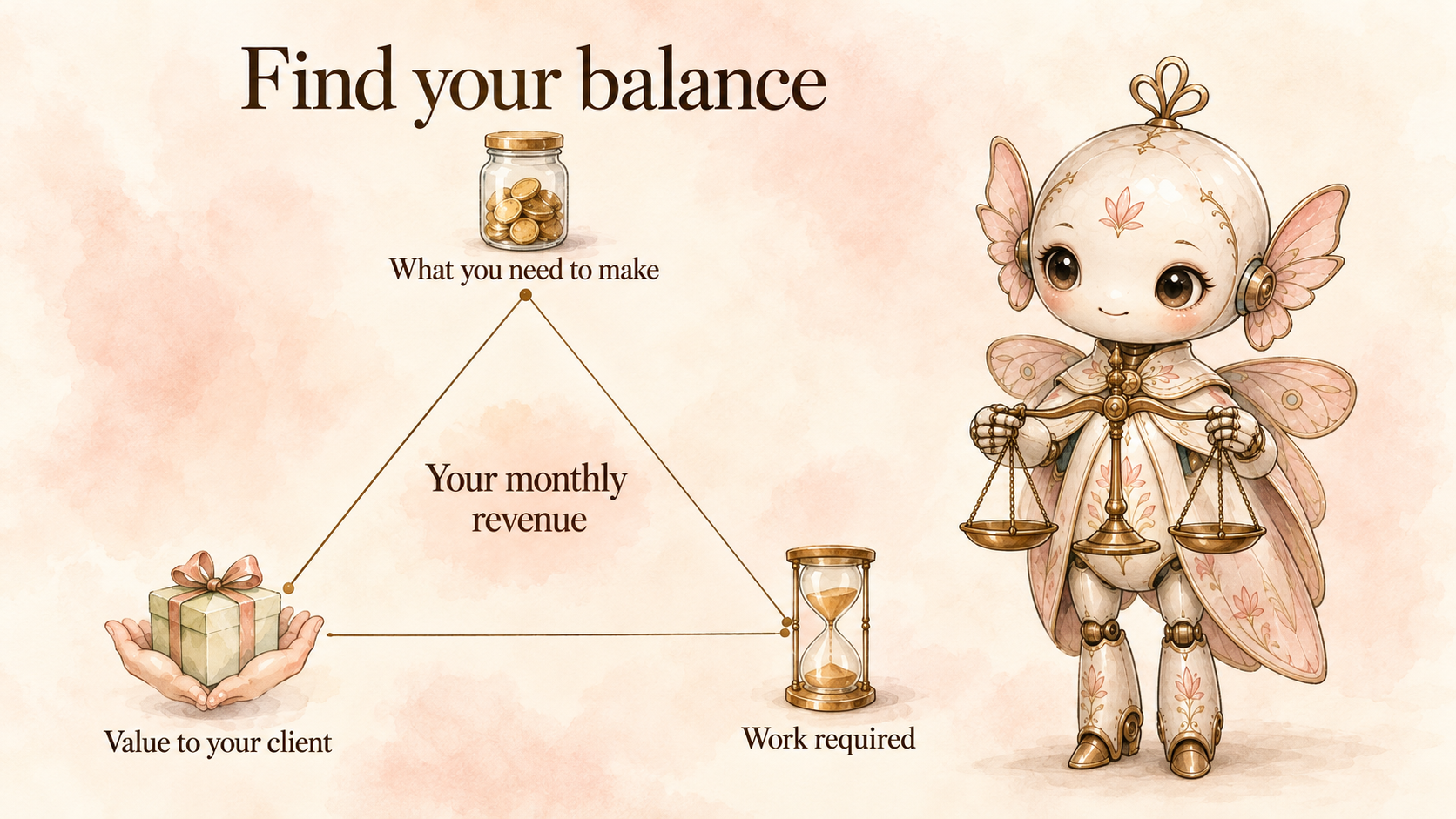
You have to have all of these worked out otherwise you end up falling out of alignment and overcommitting to working more hours than you have, devastating clients and eventually impacting your earning potential because clients are leaving you.
Group, one-on-one, hybrid, or course: they all work, so choose the one you can deliver consistently
You’ll have some people tell you to be a group coach. Some will tell you to do one-on-one. Some will tell you to do a hybrid, and some will tell you to do a course.
To be honest, they all work.
The question is ‘Which one is for you?’
Which one earns you the money, allows you to show up as your best self on a consistent basis, and leaves your clients happy and with the results they expected from you?
That’s the real secret you need to figure out. Then you build systems around that.

The start-up cost is low, and mindset is one of the biggest hurdles
Becoming a coach or consultant can be lucrative, and it also has one of the lowest start-up costs out there.
Everybody wants the best of the best. But to be honest, as long as you’ve got internet access, capacity, a skillset, experience and an audience with a pressing need, you can pretty much start a coaching and consulting business.
You can create content to attract your audience, if you decide to go down the content creation route. Or you can send direct messages (whether that’s emails, DMs on social media, or simply picking up the phone).
In today’s world, you can find cost effective tech solutions to support your operations, so that you’re spending less time figuring out automated systems and more time serving. Technology is one of the obstacles I hear many new coaches and consultants struggling with, but with the right support, you can overcome this rather quickly.
But the one that holds many people back is mindset. Mindset can be one of the biggest hurdles for people entering the world of coaching and consultancy.
There’s so much going on in your mind when you get started:
-
You’re worried you don’t have the experience
-
You’re worried nobody will buy from you
-
You don’t know if this is a waste of money and/or a waste of time
-
You compare yourself to the coaches saying they’re earning 7 figures, and you worry that if you can’t do the same thing, you’re not good at this
-
You worry that the way your life is set up, you can’t be successful
-
You worry that your life situation will cap your earning potential

It’s all valid. All of it. If you don’t have proof that it works, your mind is filling up the blanks and for many people, their brains are working against them. I will not pretend that I am a mindset coach, but I have been there and anytime a new challenge shows up, I find myself right back there.
I can’t guarantee that it will work for everyone, but all you can do is try. You never know for sure until you at least try.
When you hire a business coach, combine your expertise with theirs
I am not against hiring coaches because they can significantly accelerate your success. This has been my experience. But the one piece of advice I would give everyone is this: you are the one with the area expertise in your business.
If you’re going to hire a coach, this does not mean by default that you know nothing and you must do everything they say and give up full autonomy in your business.
The best relationships are the ones that combine your expertise with their expertise. They are not the ones that expect you to let go of everything you know that’s working and listen to everything they say no matter how valuable your input is.
I think I need to break this one down a bit so there is no misunderstanding…
Let’s say you are a specialist in teaching parents how to get their baby to sleep, and you want to become a coach who provides online services to parents.
You might find a coach who is great at teaching you how to position yourself online, but unless you’re hiring somebody who has been in your field, they likely won’t have your expertise as a sleep coach. Even if you hire someone in your field, you may want to run things slightly differently to suit your life. You know the challenges of your life, the coach probably doesn’t.
What you want is someone who is going to teach you how to take the best of what you know as a sleep coach and combine it with their expertise in whichever area they specialize in.
If you work with another sleep coach who has been in the business for 20 years, of course they may have something on you. That’s a different perspective. But even then, you don’t want to lose yourself in the process. Otherwise you end up sounding just like everybody else, and when you sound like everybody else, you get lost in the crowd.

Figuring out whether becoming a coach or consultant is a better fit for you?
You’ve probably heard me use both terms, coach and consultant. There is a distinct difference, and I want you to think about it as you decide which one you want to be. A coach guides someone to their own decision, and a consultant gives direction.

A coach helps someone make their own decision
If you are a money coach, you are helping somebody on their journey to making more money. You’re not making the money for them. You’re not telling them what investments to make, or what accounts to open. You’re guiding them as they own their decision.
A consultant tells you what to do and how to do it
If you are a business consultant, you are telling others what to do and how to do it. You’ve built up a ton of experience, and you likely have your own data points that allow you to pretty much predict what’s going to happen, based on trends and patterns you’ve seen in the past. People rely on you more for direction vs guidance.
Both coaching and consulting can be lucrative. You can switch between both, and you can be both. I know some who do both and call themselves “coach-sultants”. I don’t know who trademarked that word, but I’ve seen it around.
This is a second career, and it is not a shortcut
Coaching and consulting are great career moves to consider if you find yourself unable to work a 9-to-5, or part-time on a set schedule, and you still need to earn money.
This is not a shortcut, and I’m not saying you can do this without experience. The best coaches and consultants are those who have lived what they’re teaching, and they are teaching people from experience.
If that sounds like you, start with one question.
What experience do you already have that someone four or five years behind you would want help with?
This post was originally published on Business Rewritten, my Substack.